
Jeep Wrangling 101: Top Jeep Wrangler Trail-Ready Features Explained

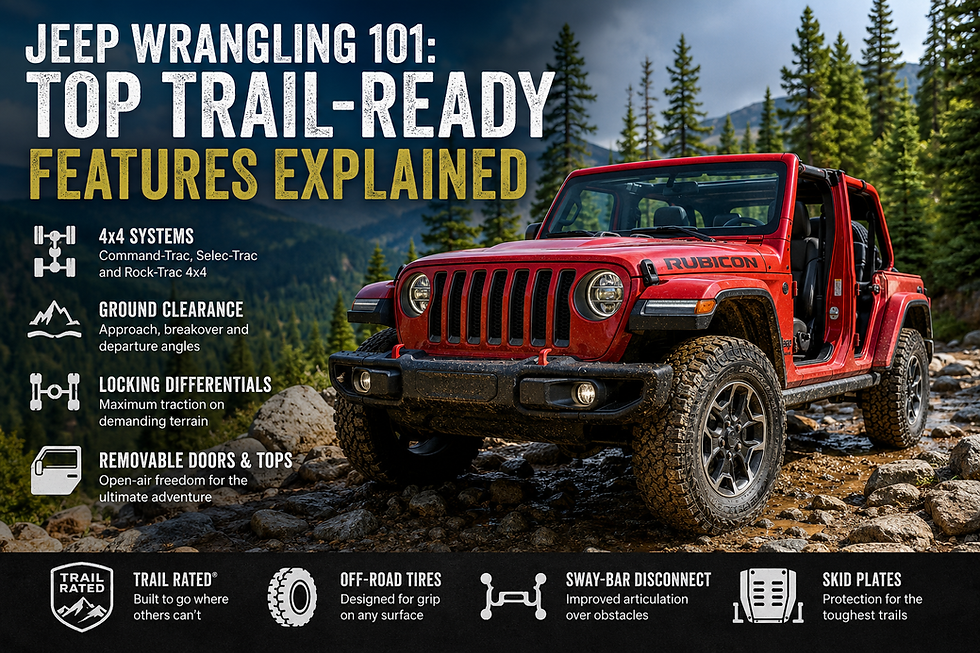
A weekday drive through Burlington may involve commuting, errands and school drop-offs. On the weekend, however, the right vehicle can take you beyond the pavement to campsites, cottage roads and approved Ontario 4x4 trails.
That versatility is central to the Jeep Wrangler. Its trail-ready capability does not depend on one oversized feature. It comes from a coordinated combination of 4x4 hardware, usable ground clearance, favourable vehicle geometry, suspension articulation, available locking differentials and open-air design.
Here is how the most important Jeep Wrangler trail-ready features work—and how to decide which ones fit your adventures.
Key Takeaways
Wrangler 4x4 systems are designed for different conditions, from mixed winter roads to low-speed rock crawling.
Ground clearance matters, but approach, breakover and departure angles are equally important.
Available locking differentials and sway-bar disconnects help maintain traction on uneven terrain.
Removable doors and roof systems create the Wrangler’s signature open-air experience.
Ontario trail access must always be confirmed through current official maps, permissions and closure notices.
Jeep Canada evaluates Trail Rated capability across traction, ground clearance, manoeuvrability, articulation and water fording.
What Makes the Jeep Wrangler Trail-Ready?
A capable off-road vehicle must do more than send power to four wheels. It must keep those wheels in contact with the ground, move slowly enough for the driver to control difficult obstacles and protect vulnerable components underneath the vehicle.
The Wrangler’s design addresses those needs as a complete system. Its 4x4 hardware helps distribute power, its suspension permits useful wheel travel, and its proportions help the vehicle approach and leave steep obstacles without immediately contacting the terrain. Protective equipment such as skid plates and available rock rails adds another layer of confidence.
Every Wrangler currently wears Jeep’s Trail Rated badge, indicating that it has been evaluated against the brand’s five off-road capability categories. Feature availability still varies by model year, trim, engine, door count and selected packages, so buyers should compare specific vehicles rather than assuming every Wrangler has identical equipment.
Jeep Wrangler 4x4 Systems Explained
The transfer case is at the centre of the Wrangler’s off-road capability. It directs power toward both axles and, on systems with low range, multiplies torque so the vehicle can travel slowly and steadily over demanding terrain.
Command-Trac 4x4
Command-Trac is a part-time 4x4 system designed to let the driver use two-wheel drive for ordinary driving and select four-wheel drive when conditions become loose or slippery.
Four-wheel-drive high range is useful on surfaces such as:
Snow-covered roads
Loose gravel
Sandy access roads
Muddy or rutted trails
Unplowed cottage roads
Because a part-time 4x4 mode connects the front and rear drivetrains, it should not normally be used on dry pavement with strong traction. Doing so can create driveline binding. Drivers should always follow the instructions in the applicable Wrangler owner’s manual.
Selec-Trac 4x4
Selec-Trac adds a full-time or automatic four-wheel-drive mode. It can respond to changing traction conditions without requiring the driver to manually switch between two-wheel drive and part-time four-wheel drive every time the surface changes.
That makes it particularly attractive for drivers travelling between cleared pavement, packed snow and wet roads around Oakville or Milton. It also retains selectable modes for more deliberate off-road driving.
Jeep Canada currently lists Selec-Trac on selected Wrangler configurations, while availability depends on trim and equipment.
Rock-Trac 4x4
Rock-Trac is the Wrangler system most closely associated with technical trail use. Offered on Rubicon models, it emphasizes low-speed torque and precise control when climbing rocks, descending steep grades or moving through deeply uneven terrain.
Low range does not simply make the vehicle more powerful. It allows the Wrangler to travel at a controlled pace without requiring excessive throttle. That can help the driver maintain a smoother line, reduce wheelspin and avoid bouncing into an obstacle.
When Should You Use 4H or 4L?
4H, or four-wheel-drive high range, is intended for conditions where extra traction is needed but normal trail or road speeds are still appropriate.
4L, or four-wheel-drive low range, is for slow, demanding situations such as steep climbs, technical descents, rocks, deep ruts, soft sand or dense mud. Jeep describes low range as a mode for situations that require increased torque at low speed.
Low range should not be treated as a substitute for careful driving. Select a safe line, keep inputs smooth and use a spotter when an obstacle cannot be clearly seen from the driver’s seat.
Jeep Wrangler Ground Clearance and Off-Road Geometry
Ground clearance is the distance between the terrain and the lowest vulnerable point under the vehicle. More clearance can reduce the likelihood of striking rocks, logs or the raised centre of a deeply rutted trail.
However, clearance is only one measurement.
Approach Angle
Approach angle describes how steep an obstacle the Wrangler can meet before its front bumper or underbody touches the terrain. Short front overhangs generally improve this angle.
Breakover Angle
Breakover angle indicates whether the centre of the vehicle can pass over a ridge without the underbody becoming high-centred. Wheelbase, ride height and tire size all affect this measurement.
A two-door Wrangler’s shorter wheelbase can be beneficial on tight trails and abrupt crests. A four-door Wrangler provides additional passenger and cargo space, but the driver may need to choose lines more carefully over sharp ridges.
Departure Angle
Departure angle measures how steeply the vehicle can leave an obstacle without contacting the rear bumper or underbody.
Together, approach, breakover and departure angles explain why two vehicles with similar ground-clearance figures may perform differently on the same obstacle. Jeep’s Trail Rated evaluation specifically considers these angles alongside underbody clearance.
Traction Features for Mud, Rocks and Uneven Ground
A 4x4 system can send power toward both axles, but the tires still need to turn that power into forward movement. Several available Wrangler features help when one or more wheels have limited contact with the trail.
Locking Differentials
A conventional differential allows the left and right wheels to rotate at different speeds when turning. That is ideal for everyday driving, but it can become a limitation when one wheel is on firm ground and the other is spinning in mud or hanging above a rut.
A locking differential mechanically links the wheels on an axle so they turn together. This can help the wheel with traction continue moving the vehicle.
Current Rubicon equipment highlighted by Jeep Canada includes an available Tru-Lok electronic locking differential. Certain Willys configurations also list a locking rear differential. Lockers are intended for deliberate, low-speed use on appropriate loose terrain—not routine cornering on high-traction pavement.
Electronic Sway-Bar Disconnect
A sway bar helps control body movement during ordinary driving. On deeply uneven terrain, however, it can restrict how independently the front wheels move.
The Wrangler Rubicon’s electronic sway-bar disconnect allows greater front-axle articulation in suitable off-road conditions. More articulation helps the tires remain in contact with the ground while the vehicle crosses rocks, washouts and offset ruts.
Dana Axles, Off-Road Tires and Protection
Depending on the configuration, Wrangler models may include heavy-duty Dana 44 axles, all-terrain or off-road tires, rock rails and protective skid plates. Jeep Canada currently lists 33-inch off-road or all-terrain tires on selected Willys and Rubicon models, along with heavy-duty Dana axle equipment on certain four-door configurations.
Tire choice is especially important. A large tire is not automatically the best tire for every owner. Consider tread design, winter performance, road noise, sidewall strength, replacement cost and how much of your driving will occur on pavement.
Removable Jeep Doors and Tops
The Wrangler’s removable doors and roof systems are not traction devices, but they are an important part of its adventure identity.
Jeep offers removable soft-top and hardtop configurations, along with an available Sky One-Touch power top on selected models. Current models also feature quick-release door-hinge hardware intended to simplify door removal.
Removing the doors can create a stronger visual connection with the terrain and make it easier to understand the vehicle’s position relative to nearby obstacles. It also changes the vehicle’s protection and equipment:
Side-impact protection is reduced with the doors removed.
Loose equipment must be secured.
Seatbelts should always be worn.
Factory mirrors may be attached to the removed doors.
Applicable mirror and public-road equipment requirements must be followed.
Jeep Canada’s door-removal guidance notes that removing the doors also removes the attached side mirrors on applicable vehicles and recommends an appropriate doors-off mirror solution.
Which Wrangler Features Fit Your Adventure Style?
Scenic Roads, Winter Driving and Cottage Access
Drivers who primarily travel on pavement but regularly encounter snow, gravel and maintained access roads may value a Wrangler equipped with Command-Trac or Selec-Trac. Selec-Trac can be especially convenient when traction changes repeatedly during a trip.
Camping and Overlanding
A four-door Wrangler may suit drivers carrying passengers, tents, coolers and recovery equipment. All-terrain tires, skid plates and practical cargo organization may matter more than the most aggressive rock-crawling equipment.
Technical 4x4 Trails
Drivers planning to tackle rocky, deeply rutted or highly uneven routes should look closely at Rock-Trac, locking differentials, electronic sway-bar disconnect, rock rails and suitable off-road tires.
You can compare available door configurations, trims and 4x4 equipment through Unique Chrysler’s Jeep inventory. Inventory changes regularly, so confirm the exact equipment installed on the individual Wrangler you are considering.
Finding Legal Jeep and 4x4 Trails in Ontario
Owning a trail-ready Wrangler does not create permission to drive wherever a route appears on a map. Land ownership, vehicle classifications, trail rules, permits and seasonal closures must be confirmed before every trip.
Drivers leaving Burlington, Hamilton and neighbouring communities can begin their research with these resources:
The official Ganaraska Forest Trails Map displays current trail notices and restrictions. A membership or day pass is required, and motorized activity is restricted to permitted portions of the East and West Forest. The Central Forest is maintained for passive use.
The Ontario Federation of 4WD Recreationists trail resources provide trail news, maintenance information and access to a searchable trail index. The index includes ratings, status reports, descriptions and downloadable route information for members.
The Ontario Trails Council four-wheel-driving finder can help drivers identify routes associated with four-wheel-drive recreation. Always verify access with the actual land or trail manager.
Ontario’s Crown Land Use Policy Atlas can assist with initial land-use research. The province cautions that its maps are illustrative and should not be treated as proof of legal access or as a navigation tool.
An ATV route is not automatically open to full-size highway vehicles. Similarly, an old logging road, online GPS track or visible tire path does not establish public access. Stay on approved routes, respect closures and never enter private property without permission.
Prepare Before the Pavement Ends
Before an Ontario trail trip:
Inspect the tires, spare tire, fluids and visible underbody components.
Carry suitable recovery equipment and know how to use it safely.
Download current maps before losing cellular service.
Tell someone your route and expected return time.
Travel with another capable vehicle on remote or technical routes.
Secure cargo, recovery equipment and open-air accessories.
Avoid widening mud holes or creating bypasses around obstacles.
Pack out everything you bring into the area.
Jeep Canada also recommends inspecting the vehicle and all five tires before off-road travel and suggests travelling with another vehicle rather than exploring alone.
Start Building Your Wrangler Adventure
The best Wrangler is not necessarily the one with every available off-road feature. It is the one equipped for the terrain you genuinely intend to explore.
A driver focused on family camping may prioritize four-door access, cargo room and an easy-to-use roof system. Someone pursuing technical 4x4 trails may put Rock-Trac, axle lockers, articulation and underbody protection at the top of the list.
The team at Unique Chrysler can help drivers from Burlington and across GTA West compare those priorities with integrity, transparency and attentive customer care. Start by exploring the current Jeep inventory in Burlington and identify the configurations that match your adventure plans.
For purchase planning, visit the Unique Chrysler finance centre. When reviewing any financing option, consider the disclosed APR, loan term, down payment or trade-in credit, amount financed and total cost of borrowing. Rates and approvals are OAC.
Frequently Asked Questions
Is every Jeep Wrangler equipped with four-wheel drive?
Current Canadian Wrangler models are built around 4x4 capability, but the specific system and operating modes vary by trim and configuration. Confirm whether the vehicle has Command-Trac, Selec-Trac or Rock-Trac before purchasing.
Do I need a Wrangler Rubicon for off-roading?
Not necessarily. A properly equipped Wrangler with suitable tires can handle many gravel roads, camping routes and moderate trails. Rubicon equipment becomes more valuable when your plans involve technical rocks, deep articulation, steep obstacles or situations where locking differentials are regularly required.
Can I use four-wheel-drive low range on normal roads?
Low range is designed for slow, demanding off-road conditions. It should not be used for routine driving on dry pavement. Follow the shifting procedures and operating limits in the owner’s manual for your specific Wrangler.
Are Jeep Wrangler doors and tops removable?
Wrangler roof and door options vary, but Jeep offers removable hardtops, soft tops and door systems on current models. Always use the supplied instructions, store removed components securely and address mirror requirements before driving on public roads.
Where can I legally drive a Jeep off-road in Ontario?
Use managed, approved routes and confirm that full-size 4x4 vehicles are permitted. The Ganaraska Forest map, OF4WD resources and Ontario Trails Council directory are useful starting points, but current permission, permits, vehicle requirements and closure notices remain the driver’s responsibility.
--------------------------------------------------------------------------------------------------------------------------
With over four decades in the automotive industry, Dealer Principal Rick Paletta is a trusted name across the Hamilton–Burlington region. Born and raised locally, Rick is respected for his integrity, work ethic, and people-first leadership—and he still loves this business because it’s about helping neighbours, building relationships, and matching people with vehicles they’re excited to drive. His commitment to the community shows up in consistent giving, including long-running support of McMaster Children’s Hospital through Car Nation Cares.


Comments